
AI can analyze a report in seconds. But it can’t read people.
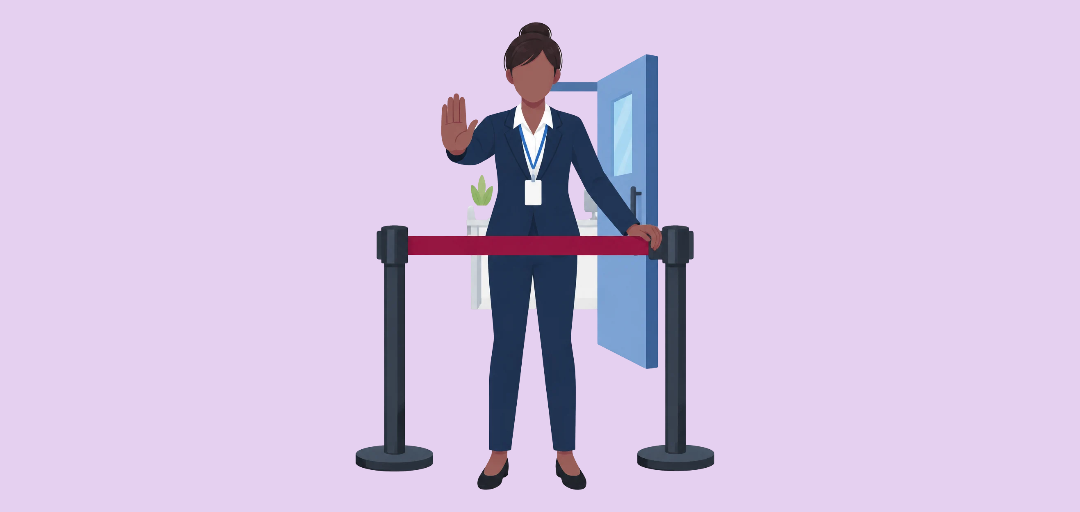
With artificial intelligence (AI) automating basic admin tasks (writing emails, drafting presentations, handling general customer service issues), it’s necessary to remind ourselves why there’s still a human advantage AI cannot replicate. High-level soft skills are an exclusive advantage humans have over machines and tools. Gatekeeping, how one controls access to a person, resources, or opportunity, is one such high-level soft skill that administrative assistants have expertly engaged in long before the widespread adoption (and evolution) of AI.
Origins of Gatekeeping
The term “gatekeeping” entered the scene in the 1940s, thanks to Kurt Lewin. He originally introduced the concept in the context of food supply chains, explaining how “channels” of movement were regulated by “gatekeepers” who decided what entered or left at each stage. Not long after, the media and journalism industry applied the concept to determine which information was worthy of dissemination to the general public. Nowadays, we often encounter gatekeeping through automated bots or prerecorded customer service prompts. They’re designed to address our most frequently asked questions before deciding when we need an actual human to step in and help us solve a problem.
Nuances of Gatekeeping (and why AI can’t replicate it)
There are shades to gatekeeping, levels of access to grant depending on the need and person(s) requesting the permissions. AI doesn’t do nuances. It can’t fully replicate the judgment humans use when interacting with each other. Nuance changes how we interpret or understand something. Body language and intonation are subtleties people recognize in each other that often communicate something unspoken. AI cannot process small changes in behavior to the same degree their human counterparts can. It can only process information we give it.
If you’re into Marvel Movies, you may recall the character Drax, from Guardians of the Galaxy. His species is known for their literal understanding of the world. In fact, if you Google “why is Drax so literal,” you’ll see this as one of the explanations: his alien species (or his specific background) does not process metaphors, sarcasm, or abstract idioms.
In other words, Drax is never the person you assign to “read the room”. And while this makes for many funny moments in the Marvel universe, his personality can also be viewed as insensitive, rigid, or “out of touch”. That’s the gatekeeping hiccup with AI; it’ll never be able to read people as well as humans can. And here’s why: despite technology’s continued advancement, it’ll never be as complex as the humans who program it. Sorry, not sorry, Silicon Valley.
Relevance of Gatekeeping
Interpersonal skills such as gatekeeping are timeless professional traits. And our businesses, organizations, and projects will continue needing some level of access control because our brains are constantly processing which information to keep and which to discard. Good gatekeeping reduces the time it takes to sort out information. Automated assistants for utility services, internet or phone companies, and Amazon are examples of gatekeeping tools we often encounter. If you have your order or account number to prompt the responses, you can typically maneuver these bots unscathed. You enter straight forward information to get a straight forward response: “your bill is due on this date”, “your order is estimated to arrive on___” and so on. Gatekeeping done.
Let’s consider an in-person exchange. It’s the second week at your new job, as an office manager. The company you work for is in the middle of downtown. You watch people walk past and come through the main entrance doors from the city streets all day long. Most stop by the desk to ask you questions. Several swipe badges for entry to the top floors. But today, a teenager walks in.
She doesn’t have an appointment, and you don’t have any notes about her arrival. She stops in front of your desk, gives her name (Reagan), and asks to see your boss. You ask a few questions to determine why she’s there. Still, in typical teenage fashion, her answers are vague and laced with irritation. You’re about to turn her away, but take a good look at her face, which looks fairly similar to your boss’s. This prompts you to call him and ask whether he’s expecting someone. He says no. You say, “Okay. Well, I have a Reagan here to see you.” He replies, “Oh, that’s my niece. She goes to school two blocks over. Send her up.”
Besides the obvious human-to-human component, as in the office manager scenario, facts AND real-time information (the resemblance of Reagan to her boss and the proximity of her school to the office) were used to grant the teen access.
Gatekeeping remains relevant because of the multiple ways it’s used to determine how much access we give customers, what opportunities we offer, and more.
There are loads of opinions, conspiracies, and even movies about AI taking over the world. And while its intelligence increases every day, humans still have the advantage in more ways than one.